
ARK Dynamics
ARK Dynamics is one of the exhibitors showing how far motion simulation technology can move beyond conventional sim racing setups. For visitors at SimRacing Expo Charlotte, this company offers a look at a highly technical corner of the market where direct-drive motion, ultra-fast response, and precision engineering are central to the product story. ARK Dynamics presents itself not simply as a sim racing brand, but as a motion simulation company serving a wider world of XR, robotics, flight simulation, automotive testing, and immersive development.
That broader identity is important because it helps explain why the company talks so much about latency, encoder resolution, control architecture, and Stewart platform design. ARK Dynamics is addressing visitors who want to understand the underlying science of motion as much as the excitement of the experience. At the same time, the company is also bringing a sim racing specific hardware message to the show through the PDK RACER, a direct-drive 6DOF motion system designed to create highly responsive and physically convincing racing simulation.
The History of ARK Dynamics
The exhibitor submission suggests that ARK Dynamics’ sim racing product direction has been shaped by a multi-year development effort. The company states that it discovered something significant over four years of tuning and experimentation: when motion response drops below 2 milliseconds, drivers begin to feel the corner rather than only watching it. That statement is central to the company narrative because it frames ARK Dynamics as a business built around technical discovery and iterative motion research rather than simple product assembly.
On its public About page, ARK Dynamics describes itself as a pioneer in motion simulation working at the forefront of XR, or cross reality, development. The company says its goal is to create 6DOF motion platforms that combine precision, power, and creativity for developers, innovators, and immersive technology builders. This public positioning broadens the company story beyond racing and shows that ARK Dynamics wants to be seen as a platform technology company with applications across multiple industries.
The About page also explains that ARK Dynamics works closely with a community called Kinemaniacs, which it describes as the heart and ARK as the body built to bring the Portal Development Kit to market. This relationship suggests that the company is developing within an enthusiast and developer ecosystem rather than operating only as a traditional top-down manufacturer. The public site even highlights community involvement around development tools and mentions FlyPT Mover in connection with early alpha testing, reinforcing the idea that product development is linked to a wider motion simulation community.
Although ARK Dynamics appears to be a newer name in the public sim racing market, the company already presents a very defined technical identity. Public materials consistently emphasize patent-protected motion architecture, a developer-first ethos, and a mission to make high-fidelity motion more accessible and affordable. For expo visitors, that history matters because it shows a company trying to shift motion simulation from a niche premium category toward a more scalable and technically advanced platform approach.
What ARK Dynamics Does
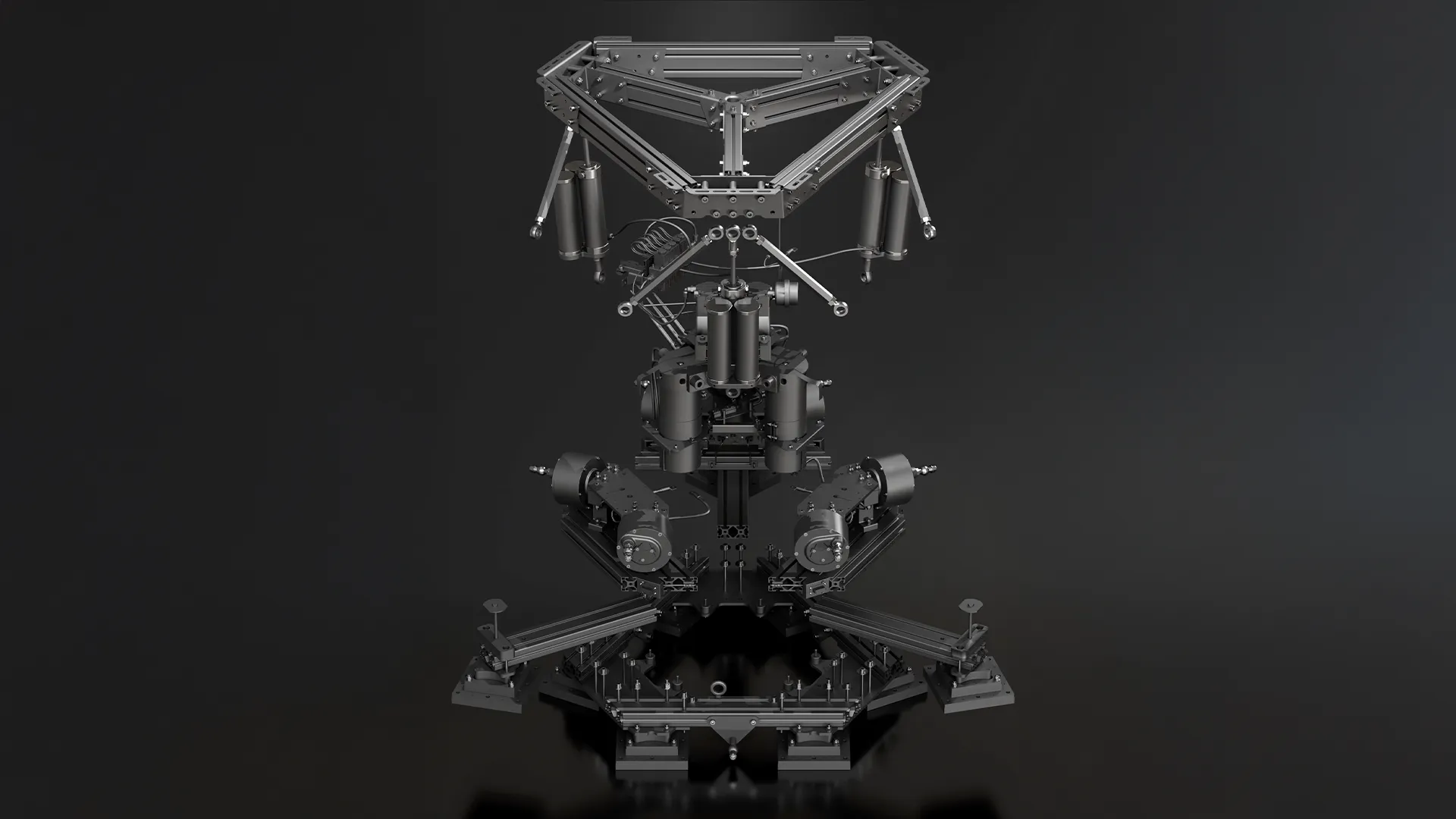
ARK Dynamics develops direct-drive motion platforms based on a modified Stewart platform architecture. In simple terms, the company builds systems that can move a cockpit or structure in six degrees of freedom, allowing users to feel surge, sway, heave, pitch, roll, and yaw. This kind of motion platform is designed to reproduce a wide range of physical cues that support simulation realism.
The public technology page describes the ARK PDK system as a patent-protected six degrees of freedom parallel robot designed to eliminate compromises found in traditional motion systems. According to the same page, the system uses six independent actuators, 21-bit encoders, direct-drive motor control, and a compact footprint around 1 square meter. Public search snippets and the About page also state that the platform is engineered for applications such as sim racing, flight simulation, aviation training, XR, robotics, and research-driven immersive experiences.
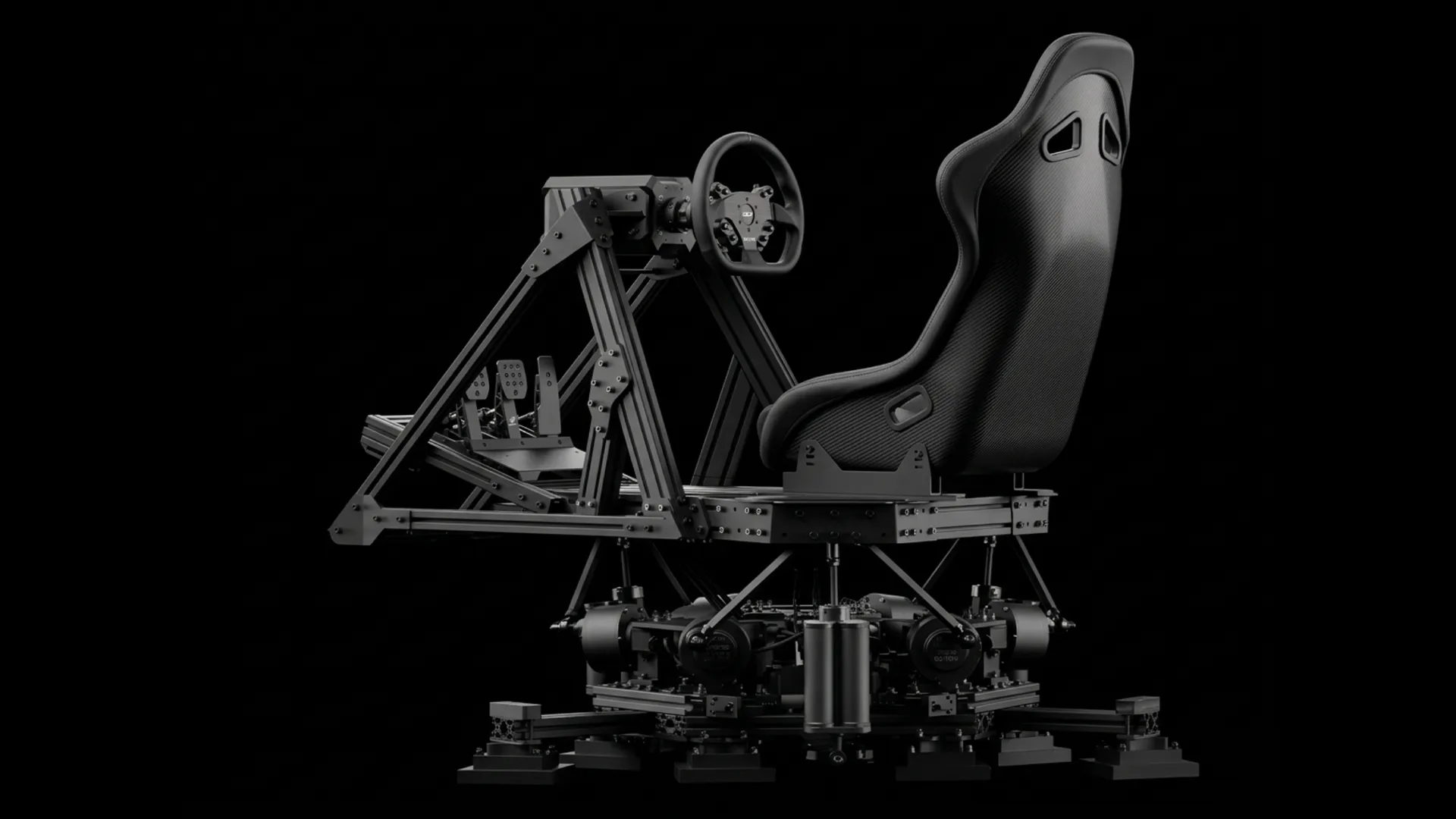
For sim racing visitors, ARK Dynamics is especially relevant because it is applying this broader motion technology to racing use through the PDK RACER. The exhibitor submission positions that product as the hardware that made the company’s four years of tuning discoveries repeatable. This means the racing product is not being marketed as a standalone novelty. Instead, it is being presented as a practical expression of the company’s motion research and control system development.
Current Products and Product Categories
ARK Dynamics’ product line can be understood through several categories. The first and most important category is 6DOF direct-drive motion platforms. The public website describes the ARK PDK as the company’s core technology and identifies it as a direct-drive six degrees of freedom motion system with patent-protected architecture. This is the technological foundation behind the company’s sim racing and simulation offerings.
The second category is PDK RACER sim racing systems. In the exhibitor submission, ARK Dynamics specifically identifies the PDK RACER as the hardware that turned its tuning discoveries into a repeatable product. This makes the PDK RACER the clearest current sim racing product for expo visitors. It is best understood as a racing-focused implementation of the broader PDK motion platform, designed to deliver extremely fast response and highly detailed vehicle cues in a driving environment.
The third category is developer and platform configurations. The public technology page describes several system configurations, including a basic PDK platform, a PDK with extension feet, a PDK with cockpit, and a PDK with both extension feet and cockpit. This is important because it shows ARK Dynamics is not locked into one single packaging format. Some customers may want a permanent racing installation, while others may need portability, user-provided superstructures, or a more flexible developer-oriented configuration.
The fourth category is motion platforms for wider industry applications. ARK Dynamics explicitly lists aerospace, gaming, healthcare, biohacking, robotics, XR, and simulation among its target application areas. While sim racing is the most relevant context for SimRacing Expo Charlotte, this broader category tells visitors that the company is building technology with a wider industrial and research horizon. That can be especially attractive to developers, technical buyers, and innovation-focused visitors who see value beyond one entertainment segment.
Core Technology and Product Features
The PDK RACER and the broader PDK system are built around several headline technical features that define ARK Dynamics’ value proposition. The exhibitor submission emphasizes 21-bit encoders, 0.00017 degree precision, direct-drive BLDC motors, up to 2,198 newtons of pulsed force, a 250 kilogram payload, and motion response below 2 milliseconds. Public website materials sharpen some of those numbers further by advertising 1.4 milliseconds from signal input to discernible motion output and describing the technology as one of the lowest latency motion simulation systems currently advertised.
The technology page also states that the system delivers a 400 Hz frequency response, six independent actuators, and a compact design with a 1000 millimeter diameter and a fully retracted height of 500 millimeters. According to the public site, the platform supports a payload of up to 250 kilograms and uses automatic weight compensation through pneumatic cylinders working with the control system. These details matter because they show ARK Dynamics is not relying on simple marketing language. It is presenting a highly technical case around bandwidth, response time, control speed, and compact packaging.
Another major element is control intelligence. The public technology page describes a dual-processor architecture, decentralized PID control, an 8,000 Hz control loop, and advanced kinematics processing. It also says the system can operate autonomously without an external computer and supports multiple communication options including Ethernet, UART, USB, CANbus, and I2C. For less technical visitors, the practical takeaway is straightforward: ARK Dynamics is trying to build a motion system that reacts very quickly, tracks position with very high precision, and supports sophisticated integration pathways.
For sim racing, these technical features translate into one main promise: motion that is fast enough and accurate enough to feel natural rather than delayed. The exhibitor submission captures that clearly by saying that once motion response falls below the threshold of vestibular processing, something changes in how drivers experience the corner. Whether a visitor approaches this from a racing, engineering, or XR perspective, that is the core product argument.
Services Offered
ARK Dynamics appears to offer more than a single hardware sale. The first service category is developer-focused motion platform access. The public About page explicitly says the company empowers developers, innovators, and visionaries to redefine immersive experiences, while the mission statement highlights a developer-first ethos. This suggests that ARK Dynamics is structured to work with customers who want to build applications, superstructures, or custom experiences around the motion platform.
The second service area is simulation platform consultation and integration support. The company website invites businesses, developers, and investors to connect, and the configurable nature of the PDK platform suggests a consultative model rather than a fixed retail-only transaction. For buyers working in sim racing, XR, training, or experimental installations, that type of support can be essential because motion systems often need to fit specific space, payload, and application requirements.
A third service category is racing and cockpit configuration support. The public technology page describes versions of the PDK that can be delivered with or without cockpit integration, with or without extension feet, and with support for user-provided structures. This means ARK Dynamics can likely support different project scopes, from bare platform deployments to more complete racing-ready installations.
The fourth service area is research-grade motion technology for advanced use cases. The About page states that ARK provides research-quality motion technology, and the technology page lists industrial and scientific applications in robotics, healthcare, aerospace, and testing. Even for visitors focused on sim racing, this reinforces the company’s positioning as a high-precision motion partner rather than a purely consumer entertainment brand.
A fifth service category is community and ecosystem development. ARK Dynamics publicly highlights its Kinemaniacs developer community, a private Discord environment, early supporter access, and broader engagement around motion evolution. This community element is part of the service picture because it can help users and developers learn, experiment, and build around the platform over time.